
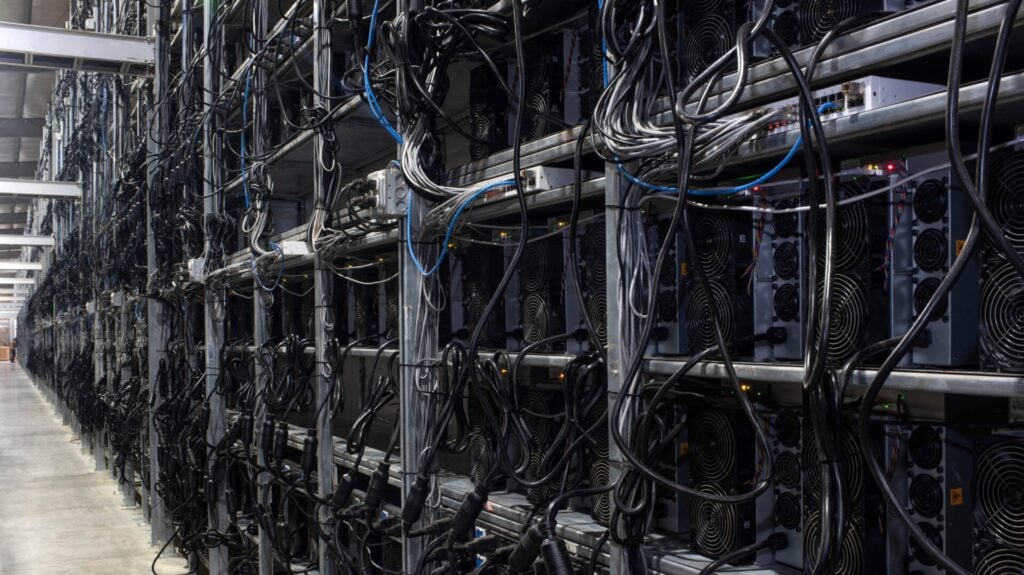
Over the past year, the bitcoin mining industry has undergone a massive shift toward artificial intelligence. In an effort to secure reliable revenue streams without relying entirely on the price of bitcoin, operators have begun repurposing their infrastructure, with some having sold off their bitcoin holdings and mining hardware to transition entirely into high-performance computing. Meanwhile, others have opted to simply diversify their data centers, selling off all or part of their bitcoin reserves while also reallocating power capacity to maintain the overall health of their businesses.
This diversification into AI has allowed bitcoin miners to land lucrative deals, such as TeraWulf’s 20-year data-center lease with Anthropic, which could potentially generate upwards of $19 billion in revenue. As more operators decide to shut down their mining rigs in search of AI profits, Bitcoin’s network hashrate has fallen well below its prior growth path. However, despite the diversification of miners into the AI industry, the long-term prospects of the bitcoin mining industry and the crypto asset itself remain strong.
Historic, But Not Unprecedented
According to a second-quarter bitcoin mining report from digital asset manager CoinShares, the total processing power of the Bitcoin network, known as the hashrate, is currently sitting roughly 50% below its expected growth trend. While significant, the report also noted that these sorts of post-halving contractions align with normal patterns seen at this point in past halving cycles. That said, this most recent drop represents the longest sustained decline in network hashrate since China banned bitcoin mining in 2021.
Despite a reduction in competition caused by miners taking their hardware offline, production costs remain elevated across the sector. Luke Nolan, Senior Ethereum Research Associate at CoinShares, noted in the report that the weighted average ex-tax cash cost to produce one bitcoin among listed miners reached approximately $75,500 during the second quarter. In fact, some operators faced production costs exceeding $100,000 per bitcoin when the asset was trading below $60,000 at the end of June. However, the asset has since mounted a significant recovery and rebounded sharply in recent weeks, climbing back up near $78,000 amidst concerns around U.S. Treasury Department buyback policies and increased sanctions that highlight U.S. dominance over the global financial system.
The Premium on Existing Datacenters
A major catalyst driving the AI pivot is the growing difficulty of constructing new data infrastructure. “A new constraint has emerged in the US that we believe is fundamentally repricing the asset base of listed miners: it is becoming increasingly difficult to build new data centres at all,” Nolan wrote in the report. “The market has responded by placing a substantial premium on capacity that already exists.”
That premium has pushed some companies to abandon mining commitments altogether. For example, Core Scientific paid $41.9 million to cancel its agreement with Block’s Proto division, walking away from roughly 15 EH/s of next-generation 3nm mining chip deliveries to prioritize AI infrastructure instead.
A Bitcoin Bull Market Could Reverse This Trend
Despite the recent dip in processing power, Nolan emphasized that the shift does not signal systemic failure for Bitcoin. Instead, public miners are simply pivoting toward a “lucrative and seemingly secular tailwind” in artificial intelligence. With network hashrate already bouncing back from earlier 2026 lows, it’s clear plenty of operators still view bitcoin mining as economically viable, which suggests the network could begin its next typical growth cycle ahead of the next halving event in 2028.
Alongside the AI compute rush, the CoinShares report attributes the hashrate drop to rising Texas energy costs seen at the beginning of the year. According to the report, high-performance computing currently generates roughly $1.5 million per megawatt annually compared to just $500,000 for Bitcoin mining. “A sustained rise in the bitcoin price could alter this calculus dramatically, however, and prompt some miners to recommit capacity to mining,” the report added.
Of course, those who have already completely pivoted and gone all-in on AI would find it much more difficult to return to bitcoin mining in a scenario where the crypto asset’s price appears headed for new all-time highs once again.


Leave a Reply