
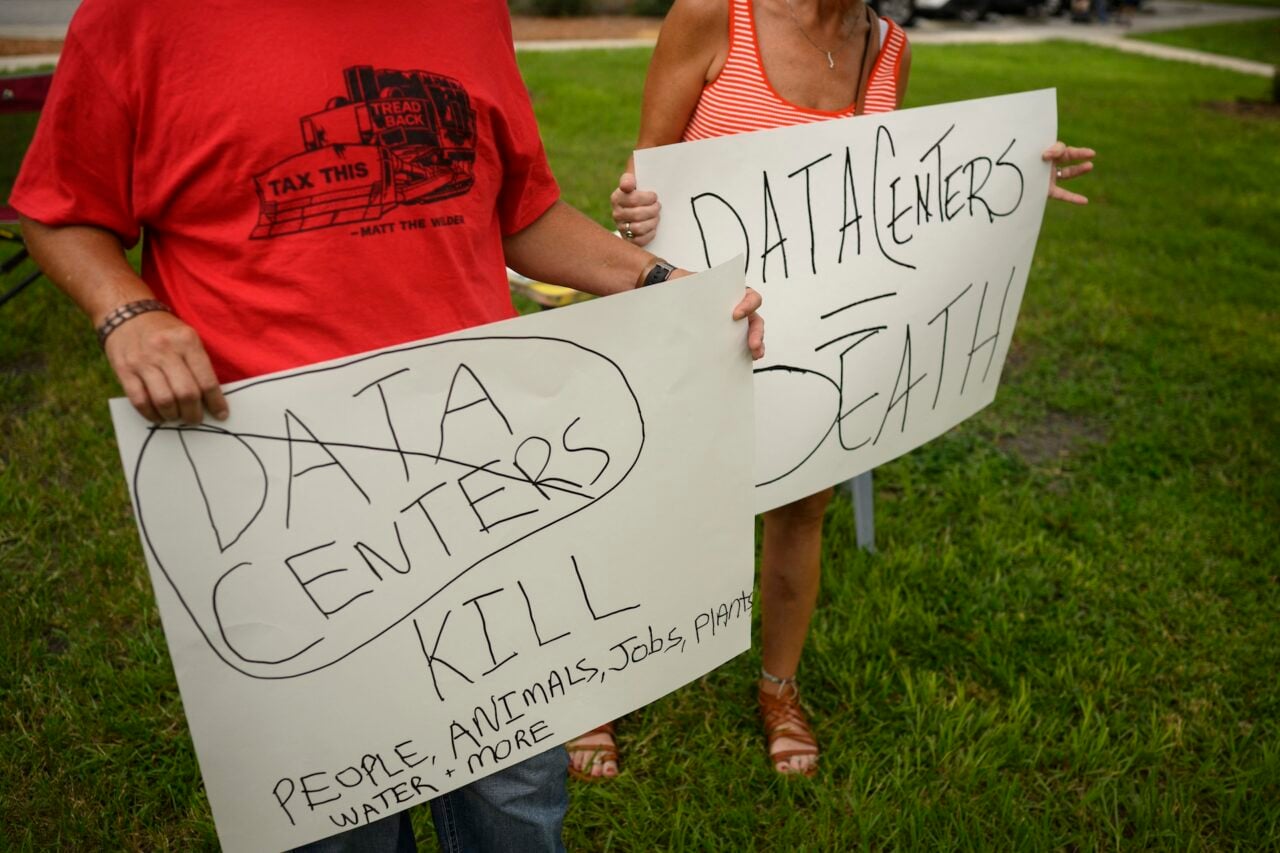
Americans’ antipathy towards AI data centers has become as noisy and impossible for politicians to ignore as the sprawling, humming, resource-guzzling facilities themselves. But rather than conceding that communities are justified in their opposition to the power hubs of the AI boom, the Trump administration is now trying to quietly sweep it under the rug.
Last month, the Environmental Protection Agency (EPA) proposed the elimination of a decades-old federal rule requiring states to solicit public feedback about industrial projects before they’ve been officially greenlit. The change, if approved, could enable tech developers to start building new data centers before neighboring communities have a chance to voice their thoughts on the matter—or even learn that such plans are in place.
The EPA says it’s doing this all for the sake of efficiency and local empowerment. “This approach is intended to reduce administrative burden and responsibly speed up permitting, supporting American economic development and energy dominance,” the agency wrote in a press release dated July 1, when the change was first proposed. “If finalized, it would put state and local agencies most familiar with local issues in the driver’s seat to determine whether, when, and for how long to provide opportunities for public participation for proposed new minor sources and modifications.”
Under the 1970 Clean Air Act, state officials are required to “offer a minimum 30-day public comment period,” according to the EPA’s website, during which community members can comment on plans to construct new industrial facilities. The proposed change would scrap that mandatory comment period for what the EPA calls “minor sources” of air pollution, such as data centers and steel mills, which the agency defines as any source emitting less than ten tons of hazardous air pollutants per year.
While data centers are officially categorized as “minor sources” of pollution, all of them together add up to a major ecological footprint. A recent analysis from the Financial Times found that the sixty biggest data centers currently under construction will together emit a total of around 101.5 million tons of carbon dioxide each year once they’re up and running.
A letter submitted Monday in opposition to the agency’s proposal was signed by the attorneys general of over a dozen states, as well as those of three cities (Washington, D.C., New York City, and Chicago). The proposal has also been opposed by nearly two hundred advocacy groups. “For more than fifty years, EPA’s regulations have required public notice and an opportunity to comment on preconstruction air pollution permits,” the Southern Environmental Law Center, a nonprofit, wrote in a public comment about the EPA’s proposal:
“That longstanding federal requirement reflects the reality that public review improves permitting decisions by identifying underestimated emissions, inadequate pollution limits, insufficient air-quality-impacts analyses, and other errors before construction begins. […] Unfortunately, EPA now proposes to move in the opposite direction, authorizing state and local air agencies to issue preconstruction air pollution permits in secret, without any public notice or opportunity for comment.”
Trump has long framed the AI race between the U.S. and China as a battle for control over the future geopolitical order, so it’s not surprising that his administration is doing everything in its power to maintain the lead in that race—no matter the cost. Earlier this week, the president said Americans pushing back against data centers in their area are misinformed, and that “smart communities” would welcome these supposedly job-creating facilities with open arms. (While there is some evidence that some data centers create new jobs, this growth is relatively modest, and arguably offset by a rise in energy bills and home prices.) He also repeated the claim, previously voiced by some Republican lawmakers, that public opposition to data centers among the American public is the result of a psy-op perpetrated by foreign adversaries.


Leave a Reply