
The PC doesn’t feel personal anymore.
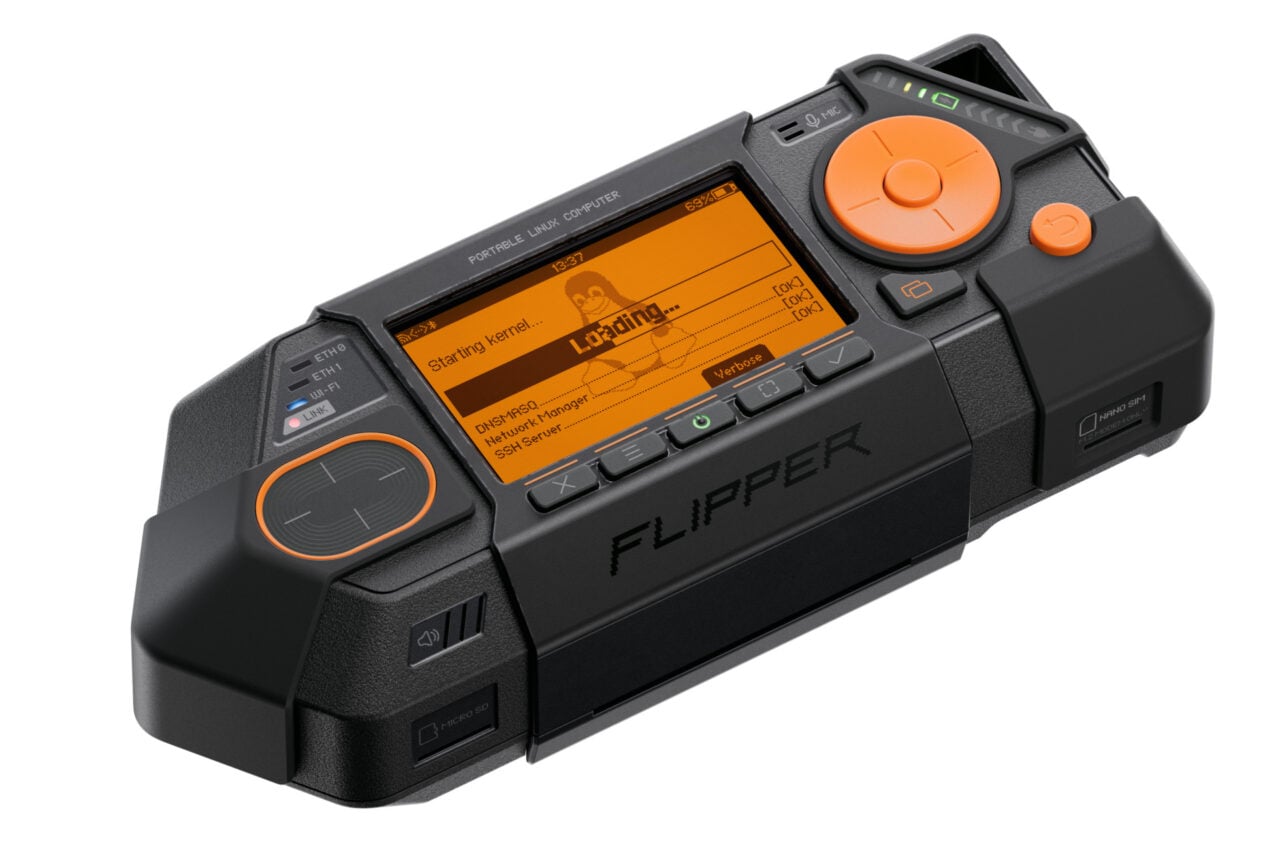
That was the all-too common sentiment Flipper co-founder and CEO Pavel Zhovner shared with Gizmodo as he talked up his company’s latest device, a “network multitool” called Flipper One. In effect, it’s a small PC built to be as customizable as you need it to be. If you’re the type to read Gizmodo, you’ve probably seen enough cyberdecks around that you’ve imagined building your own small, cyberpunk-flavored computer. Flipper wants to get you halfway there with the help of a single-board computer and a dolphin mascot aiding your journey into network computing.
Flipper’s last device was a big “f*** off button” called the BUSY Bar, but the company’s big claim to fame is the signal hacking device called Flipper Zero. By comparison, Flipper One is meant to be its own beast, or at least a sidekick to that device’s NFC and low-level RFID connectivity. In a video interview with Gizmodo, Zhovner said that the goal of this new gadget was to fix many of the personal bugbears he had with other DIY computers. Mainly, he doesn’t enjoy the one-cable power connection requirement of a Raspberry Pi-based device.
He also found that many cyberdecks running open-source operating systems based on Linux often required a mouse or trackpad to click on teeny tiny images on a phone-sized screen. As such, Flipper designed the Flipper Zero so that users could navigate it using a simple D-pad interface and several programmable buttons. While the team’s still working out the layout of the UI, Zhovner said the device could also support its own Flipper OS and app store, just like Flipper Zero. The company is sharing its entire development process online and asking its community to share ideas.
The Flipper One is running on a Rockchip RK3576 processor, which Zhovner said was better than a Raspberry Pi 5 in multi-core CPU performance, even if it was slightly worse in single-core settings. Flipper is building this device for networking or IP-based communications, though that’s just its base level functionality. If you were trying to add a screen to your router or reconnect your hotel internet to get the best speeds, the Flipper One could be an ace in the hole.
And if all that fails, it could potentially act as a power bank for your other devices, at the very least.
Flipper also wants to overcome one of the main issues with small-scale Linux devices—namely, usability. Zhovner said he wants to enable multiple user profiles on the small-scale computer. Each profile would facilitate a different potential use case. Say you wanted your device configured as a travel router, a home TV box, or an emergency desktop environment when on the go. The Flipper CEO said many Linux-based systems struggle to do that without completely reconfiguring the device, but he’s hoping the Flipper One will make that transition seamless.
That piece of the puzzle is going to take a lot more effort on Flipper’s part. The miniaturized computer is aiming to support Wi-Fi 6E, Ethernet, and even 5G connectivity through an M.2 module, eSIM or physical SIM. It also includes an extra PCIe expansion slot in the rear if you need a specific component that’s not built into the Flipper One. The Flipper One may take the same basic shape as a Flipper Zero, but the new model Ghovner showed me over our video call is nearly twice as big, about the size of a fist and a half in length, width, and girth.
The way the Flipper CEO put it, the device is built to straddle the line between an enthusiast device and a doohickey for folks who are merely curious about how computers work. That’s increasingly important as computing companies push cloud computing subscriptions and locked-down hardware, making the “PC” far less personal.
“Back when I was a kid, you could just buy the PC and learn how computers work. From the very beginning—I could understand how the boot system worked,” Zhovner said. “Today, all the manufacturers create their own logic that is absolutely vendor locked.”
Since its start, Flipper has worked outside the mold of computing. It may also help explain how the team got into hot water over the Flipper Zero. The radio frequency multi-tool became the item of ire for many municipalities, and even countries like Canada, due to its use in a number of reported RFID skimming and Bluetooth spamming attacks by a few bad actors. It was also purportedly used to steal office ID tags’ RFID signals and break into cars. Like any tool, its uses go beyond some binary good or evil. One tinkerer created an app inside Flipper Zero to interfere with surveillance pricing in grocery stores. The device is customizable enough that users could install their own firmware or apps.
Similar to how Flipper Zero’s technology wasn’t new by any standard, Flipper One won’t be too far out of what people expect. It’s simply trying to offer an even more open PC than what you can get on other mainline Linux devices with an interface that makes a little more sense to the folks who don’t even know what a distro is (to wit, it’s a distribution of a Linux kernel with pre-installed settings and software for navigating the OS).
This is not a device you can buy—yet. Zhovner said the company hopes to have a Kickstarter available later this year. The other big question is price. With RAM prices still spiking across the board, Zhovner said Flipper’s goal is to sell the device for around $350. That will also depend on the number of backers who put money up.


Leave a Reply